
Growing up, I was obsessed with house designs and floor plans. Grand Designs was my favourite television show.
I loved seeing the progress, from dream, to vision, to blueprint and then to tangible reality of the build itself.
One thing that I learned while watching that show was the importance of designing to the conditions and the surrounding environment, rather than purely for aesthetics or superficial appearance.
The houses to me, that shone the brightest, were the ones who did this well: they focused on the most important foundations of design, such as following passive solar design principles, staying and keeping within budget, and serving the needs and requirements of the people who would live there.
These houses seemed to me, most likely to stand the test of time.
Oftentimes, they weren’t the most showy or grandiose builds, but were the ones that were comfortable, functional and pleasing to live in and enjoy, all year round. There was generally also a simplicity to these house designs.
It inspired in me a desire to see homes designed and built on a foundation of passive solar design principles.
What is Passive Solar Design?
If you are brand new to the concept of passive solar design, this video below may help introduce you to these basic principles.
(Just a note, this video is explained in the context of a Southern Hemisphere location).
Passive Solar Design Principles
Solar Orientation
Solar orientation is quite simply, the orientation of the site or house footprint, in relation to the sun. As a general guide, the long axis of the house should run perpendicular to the direction of the sun’s light rays.
Here in the Southern Hemisphere, the sun’s light comes in from the North, relative to the equator. For those in the Northern Hemisphere, the sun’s light comes in from the South. For those in equatorial countries, the sun stays neither predominantly north or south, but rather directly high in the sky and closer to the earth.
During the winter months, the sun’s light energy is a welcome source of ‘free’ or passive energy, to warm the house. During summer however, the sun’s light energy is less welcome and the priority is to create shade from the sun’s light energy.
To strike a balance between these two requirements may seem a challenge, but there is, however, a natural phenomenon where the sun’s angle changes between summer and winter.
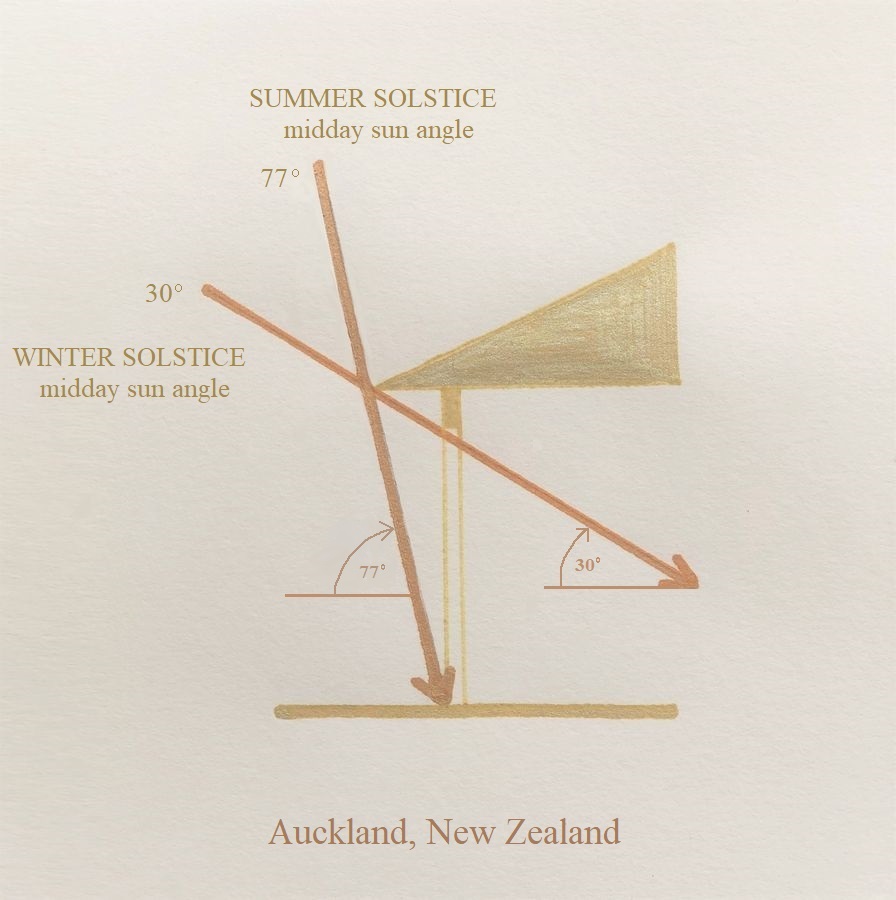
In summer, the sun sits higher in the sky, at a higher angle towards the earth, while in winter, the sun’s light rays hit at a lower angle. Therefore, it is possible to strike a balance to maximise solar exposure during winter, and maximise shade during summer.
This can be done through designing roof eaves of a particular depth, shallow enough to let the sun in during winter, but also sufficiently deep to block out the sun during summer. The info-graphic above highlights this.
Another way to create shade during summer and allow sun during winter is through deciduous tree planting. In summer, the tree’s leaves shade the sun from entering and heating the house, but in winter, it loses it’s leaves to allow the sunshine to enter. That is just one example.
Airflow or Cross-Ventilation
Cross-ventilation is especially important in warmer climates, or during summer months. Essentially it relies on the movement of air, or air currents, around and through the house, to help cool the internal temperature of the house and it’s inhabitants. Ceilings fans normally do this in most houses, however this is not a ‘free’ or passive source of cooling energy.
The passive way to achieve this is through utilising air currents, such as through breezeways, or cross-ventilation, where the air can freely move through both sides of the house to create a cooling effect. Normally, an ideal house would be narrower along its length, to allow for easier cross-ventilation, without having limiting internal structures such as walls or rooms, that may impede airflow.
The drawing below gives an example of this:
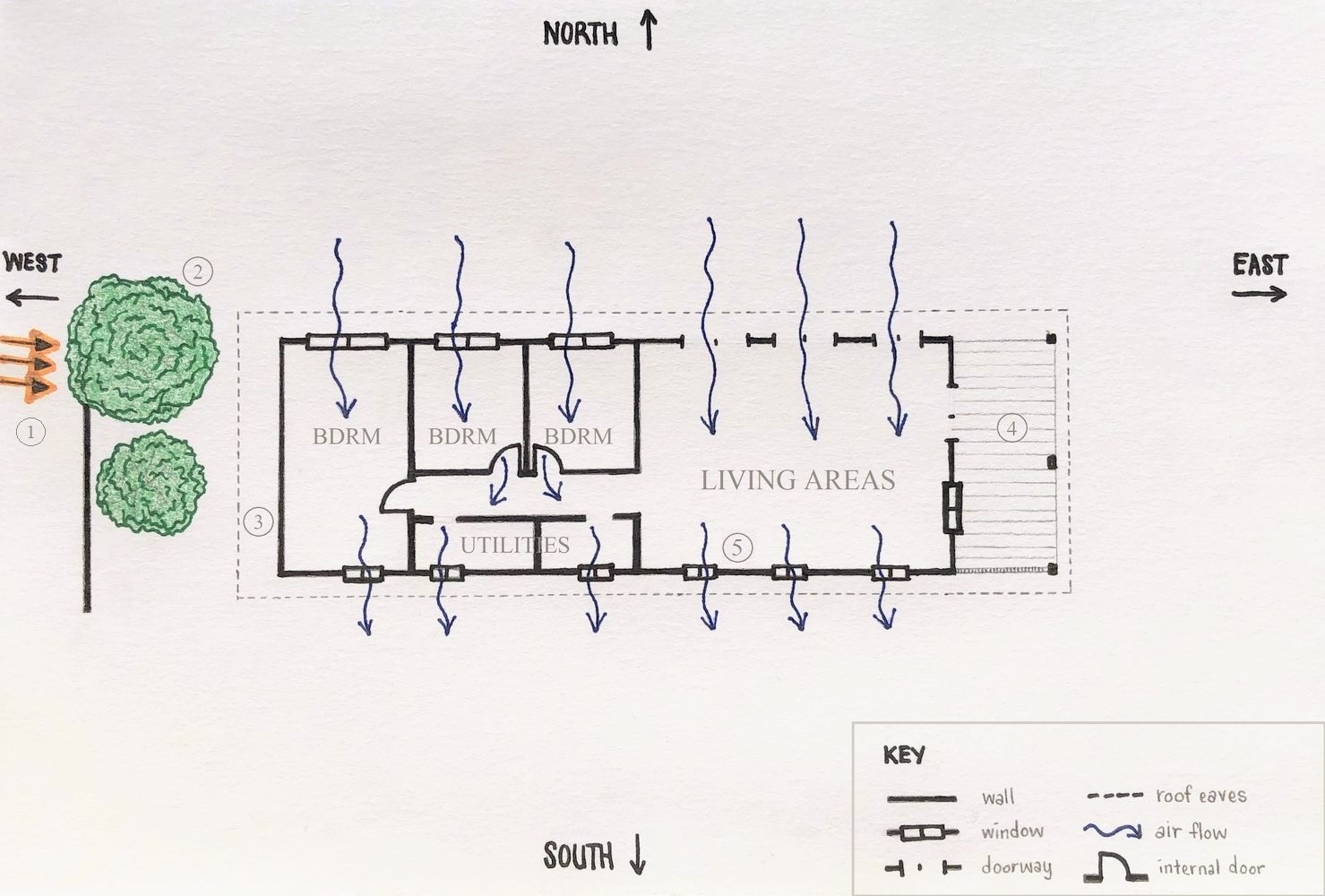
Some features I want to highlight are as follows:
(1) harsh late afternoon sun
(2) natural shade from tree planting to help shield the house
(3) deeper eaves on the western wall to shield the western wall of the house
(4) covered patio or verandah on the eastern side to limit morning sun
(5) windows on the southern side are smaller than windows on the northern side to limit heat loss in winter
Insulation and Glass Glazing
Insulation and window glazing is another very important aspect of solar passive design. Without proper insulation and glazing, the house is susceptible to massive amounts of heat loss, and even heat gain.
Using double or triple paned window glazing provides an added layer of protection or insulation. This also goes the same for wall, ceiling and floor insulation.
Getting proper window glazing and insulation designed and installed can make a big difference to how ‘passively’ your house retains or releases heat energy, and therefore how comfortable the inhabitants of the house are.
Examples of Passive Designed Houses
Bear in mind that the external and internal aesthetics of the design build are totally customisable to your style and budget.
These clips below showcase some of the features of passive solar designed houses, and why these owners chose to design them this way.